Topics covered:
1- GEO vs. SEO vs. AEO Explained Simply
2- Generative AI Search Strategy
3- Building an Integrated Search Strategy
4- Side-by-Side Comparison Matrix
5- Is SEO dead in 2026
The year 2026 has brought massive changes in every stream, including search engine optimization (SEO). Priorly, businesses focused almost exclusively on Traditional SEO, but since the launch of large language models (LLMs) and the changed algorithms of search engines, including Google, companies need to focus on this trio more often: “SEO, GEO, and AEO”.
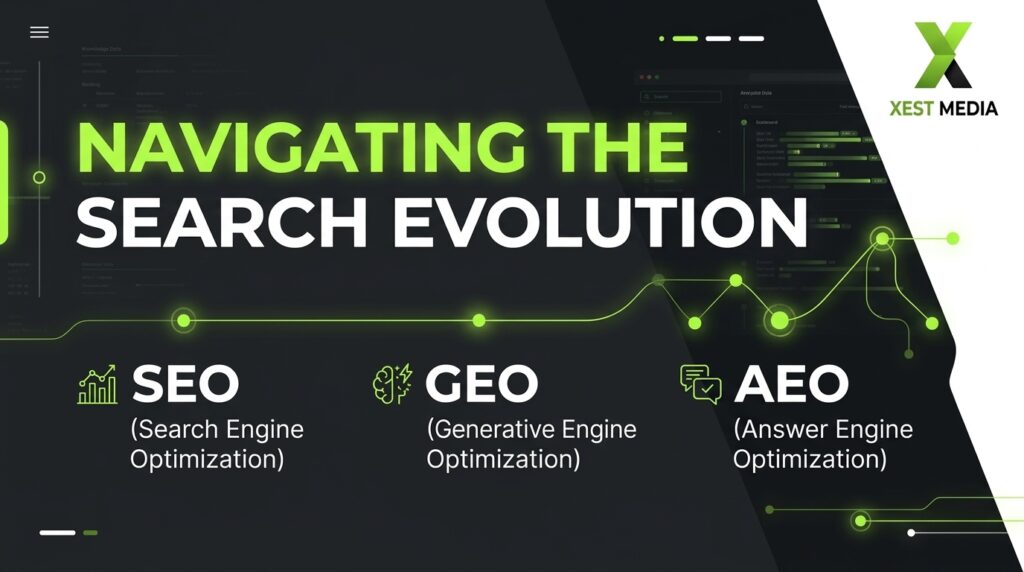
While SEO “Search Engine Optimization” ranks your web links to earn website clicks across search engines like Google and Bing, GEO “Generative Engine Optimization” builds entity authority so Large Language Models (LLMs) like Gemini, ChatGPT, and Perplexity can use and cite your brand inside conversational answers. AEO “Answer Engine Optimization” structures your data to provide direct, instant answers, such as the ones used by Apple Siri, Google Assistant, Amazon Alexa, and Google Featured Snippets, but the end goal is the same: to generate revenue. As per Google’s search perspective, optimizing for generative AI search is optimizing for the search experience, which is still SEO, but has different strategies this time.
Generative AI Search Strategy and Execution
An advanced generative AI strategy ensures your brand’s content or product is cited (shown) in large language models (LLMs) like ChatGPT, Google Gemini, Perplexity, Claude, and in AI overviews focusing on Retrieval-Augmented Generation (RAG) conditioning.
What is RAG?
Retrieval-Augmented Generation is a process that AI search engines (like Perplexity or Google AI Overviews) use to find accurate information from live website pages other than their own training data to generate user-friendly responses.
But the question is, wasn’t the same strategy followed in previous years as “SEO”? And the answer is “No”. Previously, brands that ranked were shown in the first place right after the search bar, but now AI overviews give the best possible answers.
Building an Integrated Search Strategy
A modern search strategy connects foundational technical SEO with conversational AEO and generative GEO into a single pipeline.
- Easy access: Make your site (the site’s URLs you want to be crawled) easily accessible to AI crawlers (OAI-SearchBot, PerplexityBot, ClaudeBot) in robots.txt file. Using Server-Side Rendering (SSR) gives a fully formed HTML page to the crawlers so they can read it easily.
- Entity & Schema Engineering(clear name tags): Deploy JSON-LD microdata, a standardized code format that translates your website’s content into a cheat sheet for search engines and AI bots. Moreover, put clean and accurate labels on your web content so LLMs and AI overviews can read and suggest your brand when someone searches.
- RAG & Content Extraction: Don’t let bots guess what’s inside your content. Keep your answers to 2–3 sentences, format facts into structured tables, lists, or bullets, and phrase H2/H3 headers as natural-language questions.
- Off-Page Sentiment & Proof: Nowadays, organic reviews generate business. Make sure to build a strong third-party presence, including community presence on Reddit/Quora and other online platforms.
- Target Sub-Query “Fan-Outs”: Every successive step leads to another question and eventually another answer. Build comprehensive content clusters that answer every sub-question so AI engines don’t need to consult competitors. P.S. You can always count on Xest Media with each step.
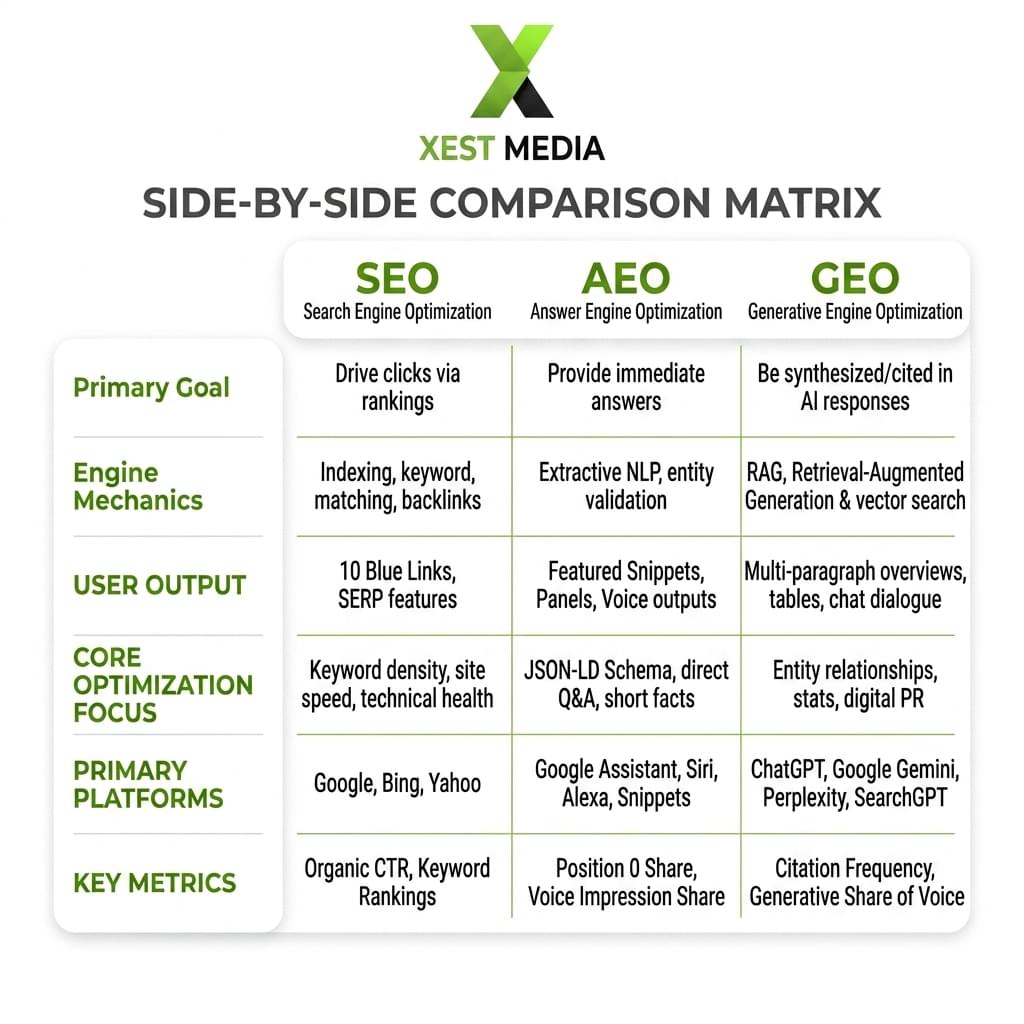
Side-by-Side Comparison Matrix:
Generative AI strategies “couldn’t” be compared, or more accurately, that “shouldn’t” be compared, as all work alongside, but let’s get a side-by-side breakdown type comparison:
Which is most important, GEO, SEO, or AEO?
To give you the direct answer: In the eyes of search engines like Google, AEO/GEO citations and traditional SEO rankings are not an “either/or”—they are a single, combined pipeline.
But SEO (Search Engine Optimization) still holds the most importance, as it is considered the foundation for being discoverable—building keyword rankings, authority, and backlinks on search engines like Google and Bing.
(h3)
GEO and AEO formatting is extremely important along with rankings longing, since people nowadays prefer to get their answer within a minute. Here, AEO formatting does work through featured snippets in AI overviews. As per OptimizeGEO, around 64% to 65% of searches ended with zero clicks in early 2026, though it significantly reduced click-through rate and hence website traffic, but getting cited in AI overview itself is a site’s achievement, a signal of trust and authority.
Furthermore, GEO ensures that when LLMs generate detailed answers and solutions to people’s problems, they pick data from your website or link your website as a source. AI Citations target high-intent buyers.” Getting cited in ChatGPT, Perplexity, or Google AI Overviews positions the company as the recommended authority, resulting in much higher conversion rates than standard traffic.
Is SEO dead in 2026?
No, SEO is not dead, but is completely transformed. What died is websites with low-quality, completely AI-generated articles, with spammy backlinks.
What is SERP?
The SERP (Search Engine Results Page) reflects your website’s position on Google, determined by how search engines evaluate and rank your content.
How to rank for SERP features?
To rank for SERP features, use clear positioning, be direct about the user’s intent, build high-value backlinks, and remove any barriers to crawlers.
High-Quality Backlinks (Authority): Google views links from other reputable websites pointing to you as votes of confidence. A strong backlink profile is still a foundation for ranking.
Do backlinks still matter in 2026?
Yes, backlinks still matter in 2026—they act as high-quality trust signals for both traditional search and AI citations. According to a Zyppy survey of 131 SEO professionals, backlinks remain Google’s second most vital ranking factor. As Cyrus Shepard mentioned in the report, “the rumor of the death of backlinks has been greatly exaggerated.” Backlinks work; just avoid spammy backlinks and use high-value, trusted ones.
- User Engagement and Trust Signals: If people click your link, stay on your page, read your content, and don’t immediately bounce back to the search page, Google learns that your site is a great answer.
- Technical SEO & Page Speed: Google rewards websites that load fast, are user-friendly, and perform well across any screen, i.e., mobile phone, tablet, and use clean code so its bots can easily scan the site. E-E-A-T (Trust Signal): Stands for Experience, Expertise, Authoritativeness, and Trustworthiness. Google wants to see clear author bios, transparency, and accurate facts, especially for finance or health topics.
What Google’s SGE and SERP prefer:
AI Overviews, previously called SGE (Search Generative Experience), and traditional SERPs (Search Engine Results Pages) prefer content that is useful, answers users’ queries efficiently, sends trust signals, and is easy for crawlers to decode using SSR.
What Pushes Your Website Into SGE / AI Overviews?
The AI doesn’t think like a traditional search engine. It prefers “productivity” over “popularity,” it scans pages for information chunks that answer a user’s prompt.
Direct Answers at the Top: The AI loves efficiency. If a user asks a question and you answer it cleanly in the first 2–3 sentences of a section, the AI can pull that exact fragment out and link to you.
Scannable Content Format: AI doesn’t see the final crafted page, but the bulk of complex code text. Use clear headings (H2s and H3s), bullet points, and clean lists that it can easily extract.
Answering “Sub-Queries”: When a user asks a long, complex question, AI divides it into short 5-6 sub-questions and answers them step by step. If your content involves NLP (Natural Language Processing) and provides the absolute best, most direct answer to one specific sub-question, the AI will pull your content into its generated response to complete its summary.
FAQ Schema Markup: Adding backend code like FAQ Schema explicitly tells the AI: “Here is a question, and here is our exact answer.” This acts as a massive green light for the model.